People who trust me enough to introduce me to someone they care about. That means a great deal, and it is not something I take lightly.
Having the plan is one thing. Knowing where to go when something is actually wrong is another. Tell me the problem — a blocked nose that needs a scope, a knee that will not settle — and I find a specialist on the panel for it and book the appointment for you. Where the plan allows it, I put the paperwork in for approval before the visit, so the bill is settled directly rather than coming out of your own pocket first.
Help me find a specialist ›
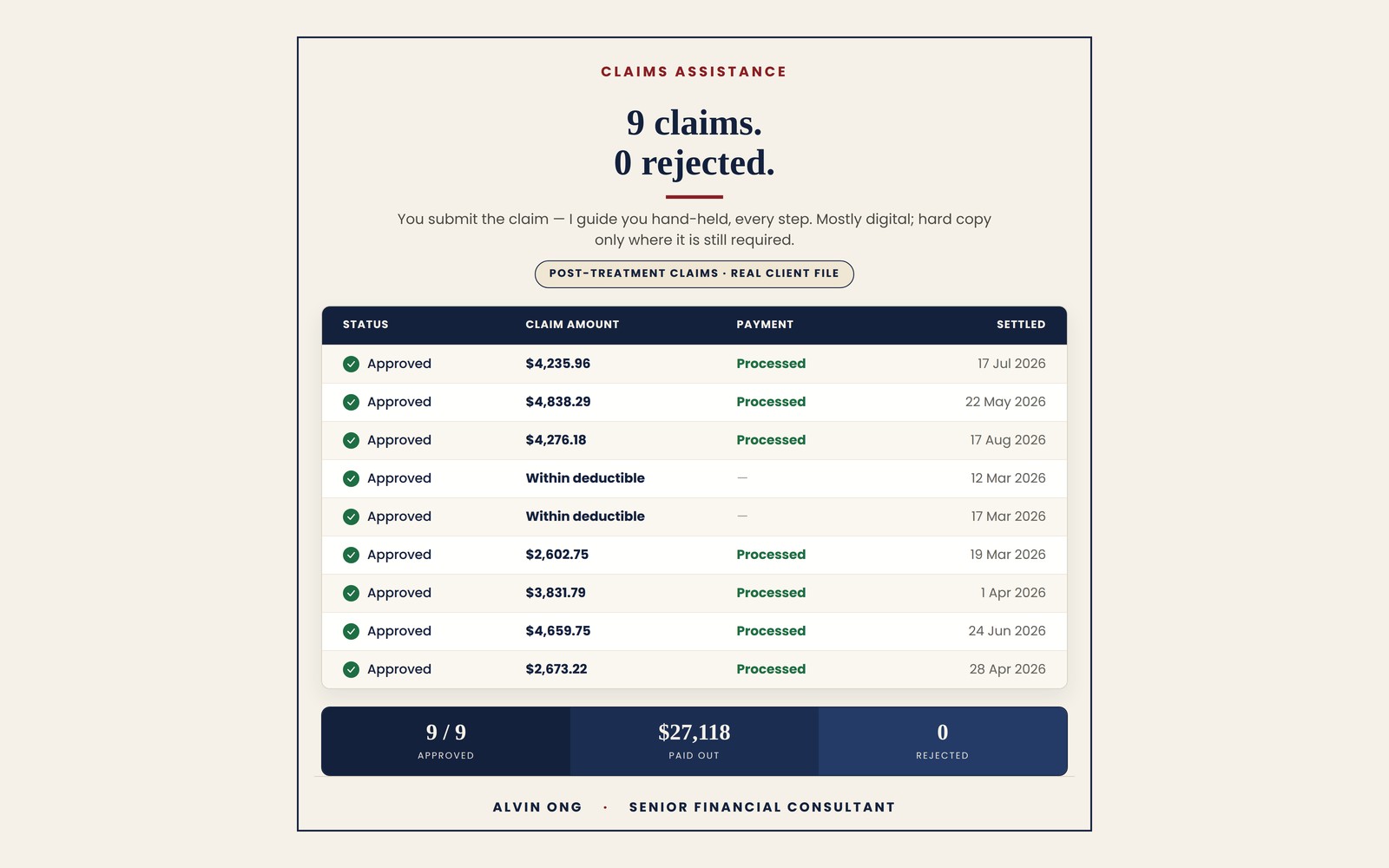
The claim has to be submitted in your name — I take you through it step by step. Most of it is done online; where a hard copy is still required, I tell you exactly what to sign and where it goes.
Ask me about a claim ›
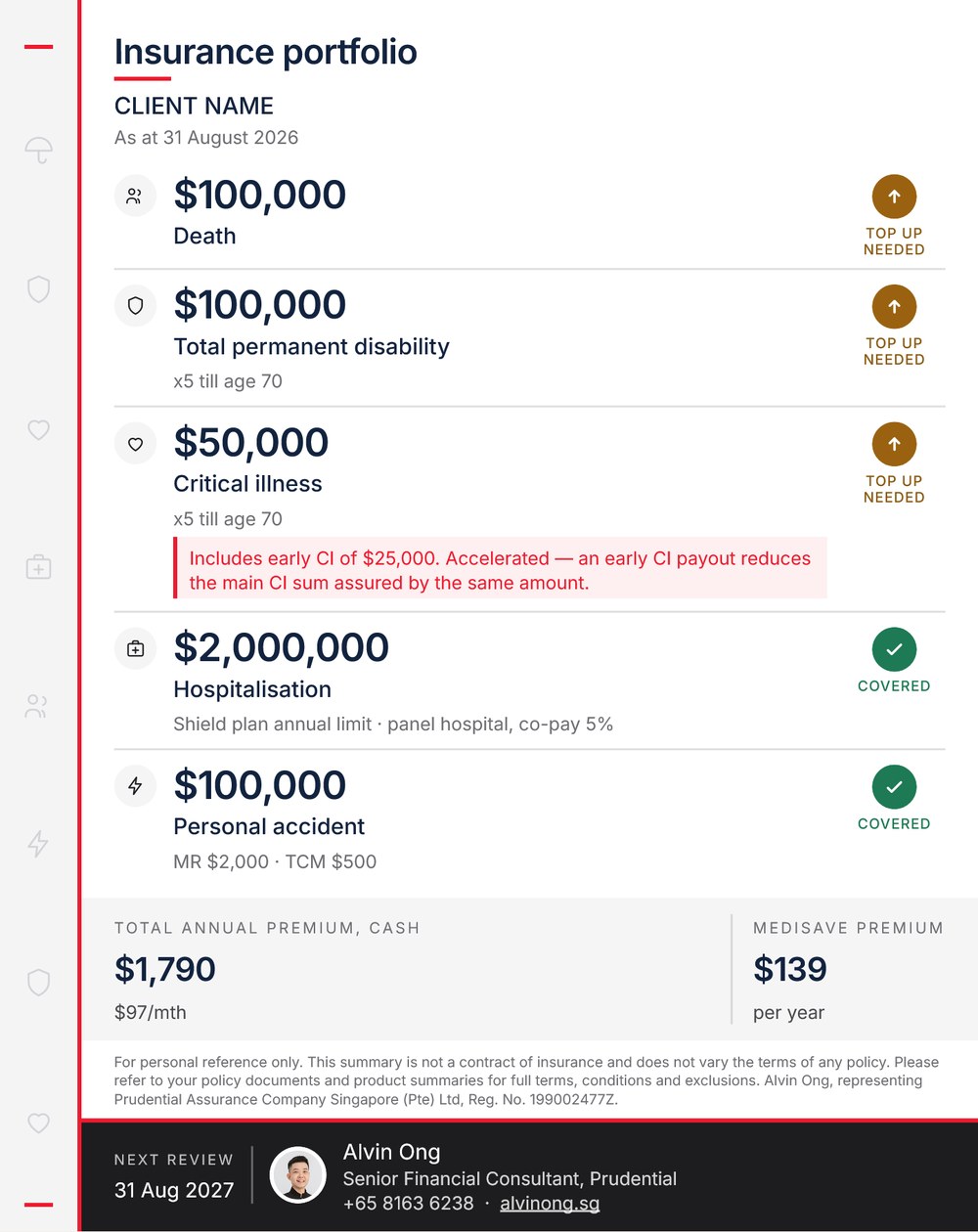
Everything you own, laid out clearly — what's covered, where the gaps are, what it costs. Free, and yours to keep whether we work together or not.
Get yours ›
Cover for mum and baby can only be arranged during pregnancy, inside a window that closes. Most parents hear about it too late.
Check your window ›
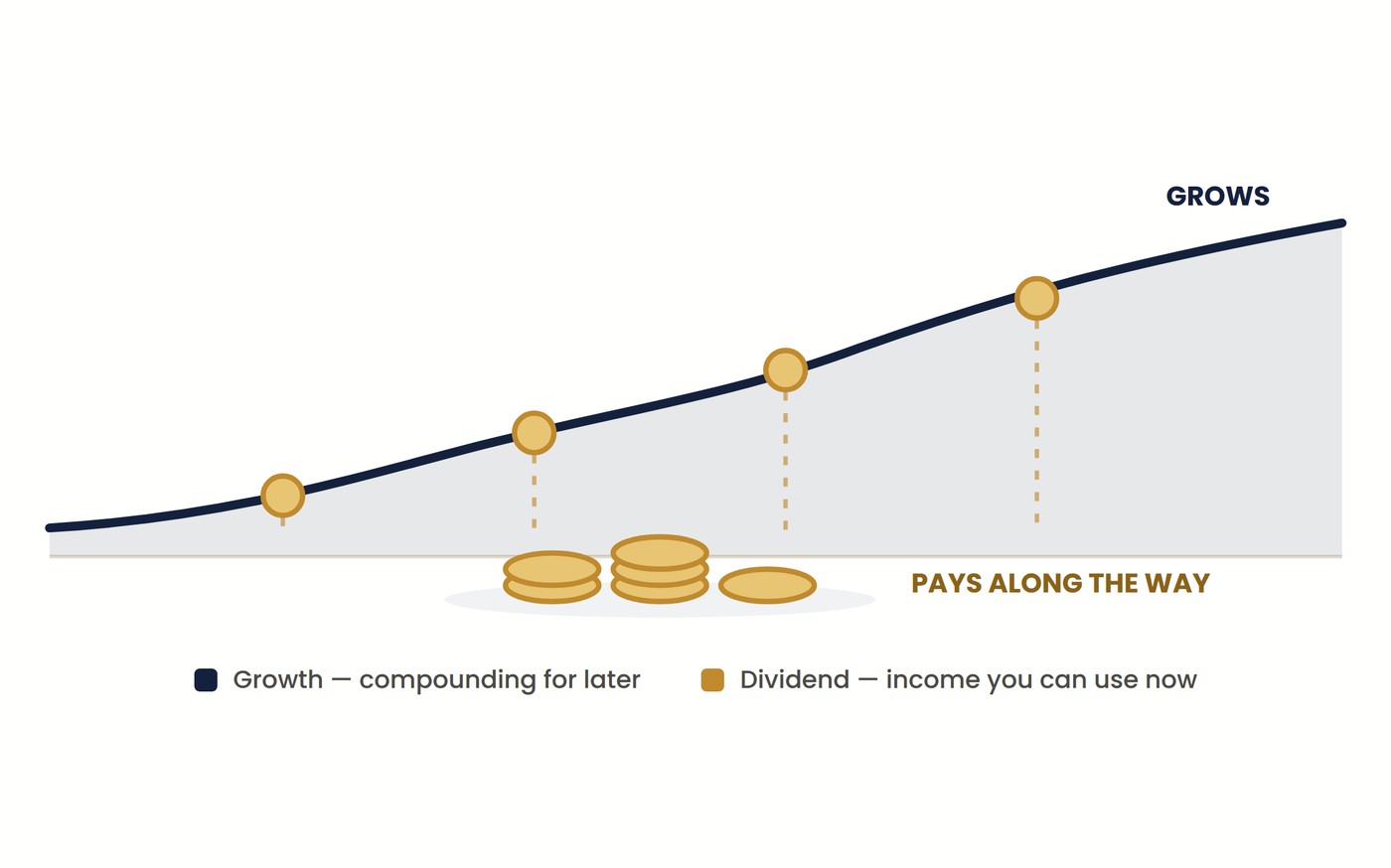
Growth and dividend, built together rather than one or the other — so something compounds for later while something pays you along the way.
Talk it through ›
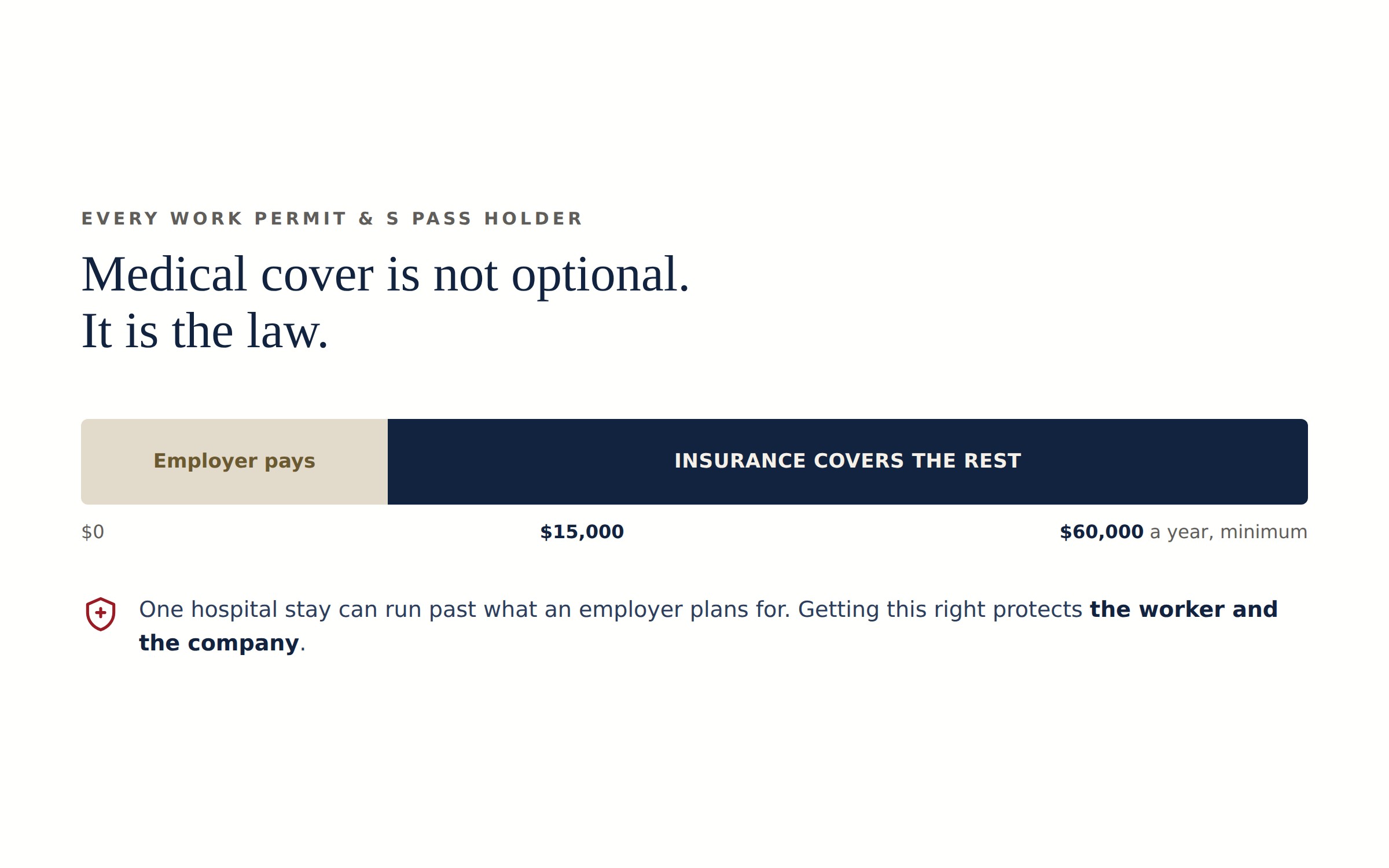
If you employ Work Permit or S Pass holders, medical insurance is a legal requirement, not a nice-to-have — a minimum of $60,000 a year per worker, with the employer covering the first $15,000. I set that up properly, alongside group term life and hospital cover for the rest of your staff.
Talk about your company ›I'm Alvin, a Financial Consultant with Prudential Singapore. I work with people across all walks of life — helping them protect what matters, plan for what's ahead, and make sense of the financial decisions that actually affect their lives.
I don't believe in one-size-fits-all plans. Everyone I sit down with has a different story, different priorities, and different things they are working towards.
If someone you trust brought you here, I hope to make that introduction worthwhile. If you found me on your own, feel free to reach out — no pressure, just an honest conversation.
Your statements are read line by line and your existing cover mapped out before we sit down — the preparation is done on my side, not yours.
After that, I stay. Policy changes, a hospital bill, a new baby, a job change — that is what the phone number is for.

“Alvin approached me during one of his roadshows. I rejected him initially, as usual, but as I had some time to spare I decided to give him a chance. He will not force, but will try his best to analyse and help wherever he can. You will not feel pressured into buying.”

“Previously if there was any Financial Consultant coming up to me, I would reject them and run away. He wasn't insistent on me buying a certain plan, explaining in detail to let me understand what I am covered for.”

“He doesn't recommend plans for the sake of it. Even after the policies were in place, he continued to check in regularly and review my coverage whenever needed.”

My son is the reason I read the fine print twice. Every plan I put in front of you is one I would be comfortable putting in front of my own family.

Most people are sold a plan before anyone explains the category it belongs to. Here is the short version of each, including the part that usually gets skipped.
You choose how long you want to be covered — say until the loan is cleared or the youngest child finishes school — and you are covered for that stretch. It is the cheapest way to hold a large payout, because you are paying for protection and nothing else.
The part people miss: it has to be kept alive. Miss the premiums and it lapses, and the cover is simply gone — there is nothing inside the policy to fall back on. When the term ends the same thing happens by design, and starting a new one later costs more because you are older, and may not be possible at all if your health has changed.
Cover that stays for life as long as the premiums are paid, usually with a limited number of paying years. Over time it builds a cash value you can surrender or borrow against, so it is part protection and part long-term savings.
The part people miss: that cash value is a cushion. If money gets tight and a premium is missed, the policy can borrow against its own value to pay itself and stay in force, instead of lapsing. That is a large part of why I often use whole life as the base of a plan. The loan does carry interest and reduces the value, so it buys you time rather than a free pass, and for the same payout it still costs more than term.
You pay in for a set number of years and the plan matures on a date you pick at the start — university fees, a property, retirement. The insurance element is small; the point is the maturity payout.
The part people miss: the projected figure is not all guaranteed, and cashing out early usually returns less than you put in. Only commit money you can genuinely leave alone until that date.
Part of what you pay buys units in funds you choose, and part pays the insurance and policy charges. You get to see the funds, switch between them, and the value moves with the market.
The part people miss: the value is not guaranteed and moves with the market, and the insurance charges are taken from your units and step up as you get older. That is normal and it is priced in from the start. It simply means an ILP is a plan to sit down with every few years, not one to file away and forget.
MediShield Life covers everyone in Singapore at a basic level. A private hospitalisation plan sits on top of it and lifts you to a higher ward or a private hospital, and an optional rider takes care of the share of the bill you would otherwise pay yourself.
The part people miss: the main plan is payable from MediSave up to the allowed limits, but the rider is cash, and it goes up as you age. Health conditions you already have may be excluded, so this is one to get in place early.
Pays out for injury caused by an accident — a fall, a road accident, a sports injury — including the clinic and treatment bills that follow. It is inexpensive, and it pays on top of whatever else you hold.
The part people miss: many of these plans also cover a list of common infectious diseases, hand, foot and mouth disease and dengue among them. For a young child in childcare that is the part of the plan that actually gets claimed. What it still does not do is cover illness in general, so it is not a substitute for medical cover.
This is a general explanation of the categories, not advice, and not a description of any particular plan. Which of these makes sense depends on what you already hold, your commitments and your budget — that is what the first meeting is for. Full terms, exclusions and charges are set out in the product summary and policy documents.